DIRECT CURRENT CHARGING STATIONS MANUFACTURERS


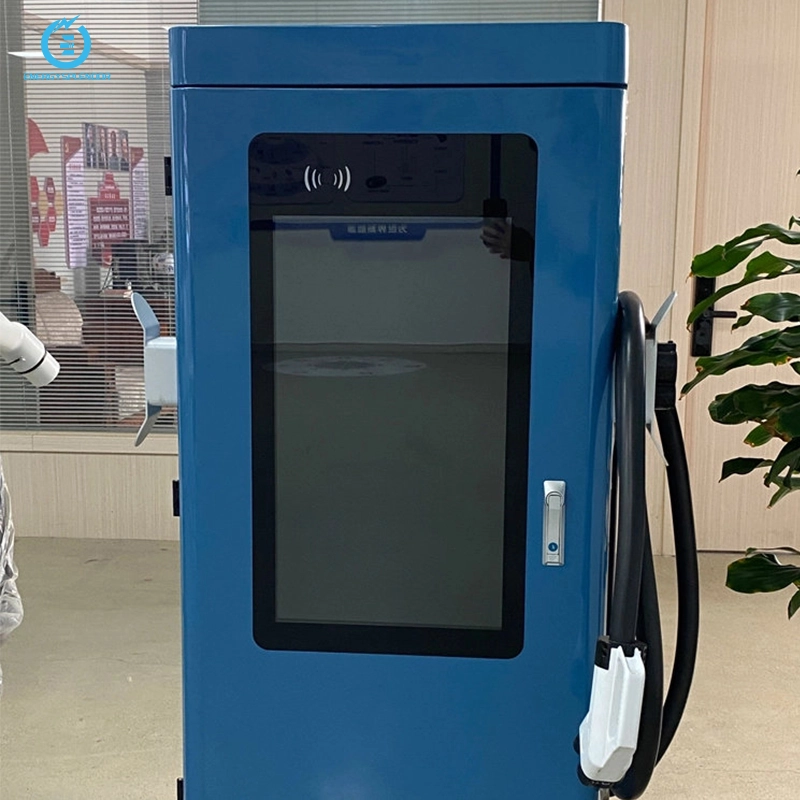
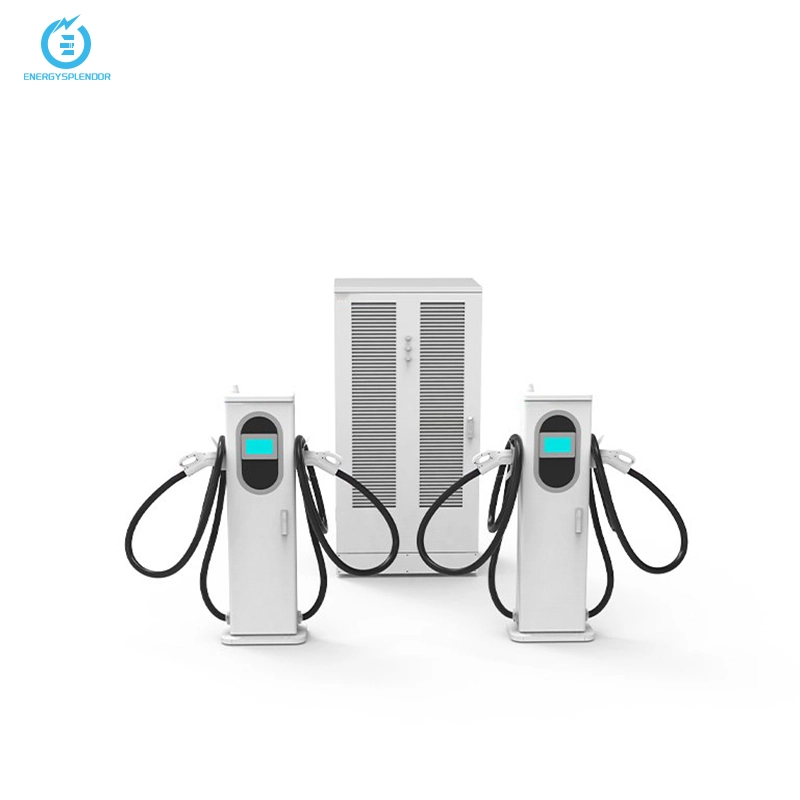
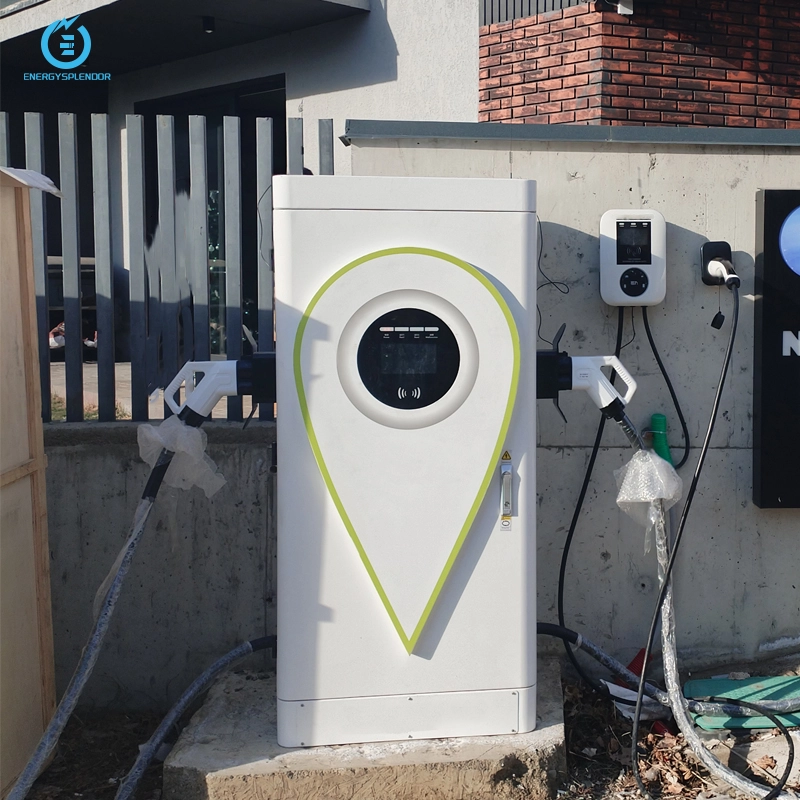
Factory Commerial Dc Fast Electric Vehicle Charging Station GBT CCS CHAdeMO
Dimension:800*800*1800(L*W*T)
Weight:<500KG
Installation Method:Floor-mounted
Screen:7 Inch LCD Screen/LED Light
AC Input Voltage:AC380V±15% ,3P+N+PEAC
Output Voltage Range:CCS1/CCS2/GBT: 150Vdc –1000Vdc;
CHADEMO: 150Vdc –500Vdc
Input Frequency:50Hz/60Hz
Charging Stands:IEC 61851-21-2:2021; IEC 61000-6-2:2019;
EN61000-6-4:2019; IEC 61851-1:2019; EN 61851-23:2014;
EN 61851-24:2014
Efficiency:≥95%
Power Factor:≥0.99(load:100%)
OCPP:1.6/2.0/2.0.1
Network Interface:Ethernet/4G
Working Temperature:-30℃~+55℃
Working Humidity:5%~95%
CHARGING POWER
Integrated AC and DC Charging Set
As a DC charging pile for commercial use, you need to understand its charging power. The greater the output power, the faster the charging speed. Our product can produce 60kw to 360kw, dual-gun charging, and has an intelligent control system at the same time. When a 60kw charging pile charges two electric vehicles, the power of each gun reaches 30kw, and when it charges one electric vehicle, the power of a single gun can reach 60kw. Of course, if you have a higher power demand, we can also produce it, such as a liquid-cooled charging pile, the power can reach 360kw, 400kw, 480kw, 720kw, etc.


INTERFACE STANDARD
Supports 99% of car models
After we understand the charging power of the local market, we also need to understand the type of car charging interface. Common ones in the market are:GBT, CCS1(NACS), CCS2, CHAdeMO, Tesla. The two charging guns of our DC charging pile can be combined in different combinations or in the same combination, providing you with more choices.
PRODUCT QUALITY
Welcome to Visit US
After we understand the basic information of the charging station market, we also need to understand the quality of the product itself. Important components of DC commercial fast charging station (just to name a few): intelligent motherboard, ac to dc module, protection module, shape components, gun line, etc. Maybe you are worried about the quality, but our products can provide CE, TUV and other certificates, and we can invite you to visit the factory or come to the factory to learn.


SECURITY PROTECTION
SAFETY FIRST
The safety of product use is the most important. Our products provide more than 12 kinds of protection: leakage protection, surge protection, overvoltage protection, short circuit protection, high temperature protection, undervoltage protection, lightning protection, low humidity protection, grounding protection, emergency stop protection, etc.
AC TO DC MODULE
Our modules have various powers: 20kw, 30kw, 40kw, including liquid cooling modules (we can also provide you with module support), and the failure rate of the modules is 0.002%.
The motherboard control module is designed independently. Our R&D team has more than 30 people, including senior engineers such as doctors, masters, graduate students, and professors.
The power control module and switch components are from well-known manufacturers such as ABB and Chint, and the quality is guaranteed.
Cable outside is TPU/TPE material.

CUSTOMZED/SERVICE
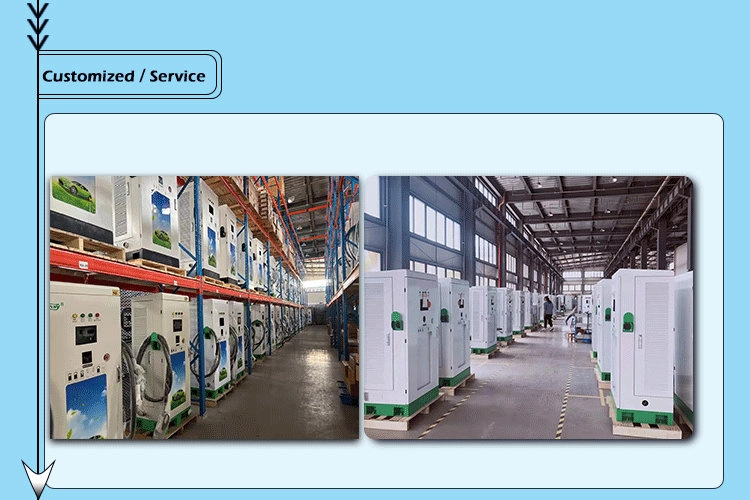
Our company can provide a variety of product customization services: Appearance customization service (within 100,000 US dollars, mold fees need to be paid) Language customization service Color customization service Gun head customization service Internal component addition customization service Product line SKD service After-sales service Remote debugging On-site guidance
“We customized a 120KW DC charging station, and it has been performing exceptionally well since installation. The charging speed is very fast, allowing most EVs to be fully charged in about half an hour, which perfectly meets our park and customer fast-charging needs. The user interface is simple, supporting card and QR code payments, and our customers have given positive feedback. The robust and durable design holds up well outdoors, operating stably even in harsh weather. Overall, it has exceeded our expectations and is highly recommended.”
Michelle Waller
“We installed the 160kW DC fast charger for our commercial site, and it has greatly improved our EV charging services. The charging speed is excellent, allowing most vehicles to charge within 20-30 minutes. Customers find it easy to use, and the payment options are convenient. The charger is reliable, durable, and looks clean on our site, operating well even in bad weather. We’ve seen more customer visits since adding the fast charger, and it has helped us improve customer satisfaction while supporting our green energy goals.”
Parker Yoder
“We are very satisfied with the electric car charging station we installed in the Philippines. The charging speed is fast, allowing our customers to quickly charge their EVs while shopping or taking a break. It is user-friendly, with clear instructions and smooth payment options, making it easy for anyone to use. The station is reliable and operates well even in the hot and humid Philippine weather. Since installation, we have seen more EV drivers visit our location, helping us support sustainable transportation in our area. Highly recommended for businesses looking to add EV charging services.”
Terrance Velazquez
“We recently added car charging stations to our facility, and they have been a great addition. The charging stations are fast, reliable, and easy for customers to use with clear instructions and smooth payment options. They work well in all weather conditions and have a clean, modern design that fits our site perfectly. We’ve seen an increase in customer traffic, and EV drivers appreciate the convenience of charging while they shop or dine. Adding these charging stations has helped us enhance customer satisfaction and support sustainable transport.”
Kim Turner
“We installed a Tesla charging station in the Philippines, and it has been a valuable upgrade for our site. The charging speed is impressive, helping Tesla owners charge quickly while they shop or relax. The station is user-friendly with a clean interface, and payment is simple, making it convenient for all drivers. It has performed reliably under the Philippines’ hot and humid weather, and customers appreciate having a fast and accessible charging option. Since installing the Tesla charging station, we have seen more EV customers visiting our location, supporting our green initiatives and customer satisfaction.”
Tom Gould
“We purchased a cheap charging station for our small EV fleet, and it has exceeded our expectations. The charging speed is decent for daily use, and the unit is easy to operate with clear indicators. Despite its affordable price, it is stable and reliable, working well in outdoor conditions. Our drivers find it convenient for quick top-ups, helping us reduce downtime and keep vehicles ready. It’s a great option for small businesses or home use looking to add EV charging without spending too much while still getting solid performance.”
Warren Hendrix
What are the advantages of charging stations?
What are the advantages of charging stations?
Electric vehicle charging stations are new technological products for social development. They are car charging equipment developed for the environmental protection of the earth and the reduction of carbon emissions. Charging station products are developing rapidly around the world. Different manufacturers have their own R&D teams (for example: ABB, Schneider, Shell, Amber, etc.). Our company also has a group of highly educated R&D talents who have been constantly updating charging station equipment. At the same time, our factory also processes for these well-known brands, which shows that our technology has been recognized by high-quality peers.
The following is just a simple list of the advantages of our charging station:
1. Germany carries out intelligent digital production equipment to improve product quality.
2. Provide at least 12 types of charging station protection functions, all using well-known brand accessories.
3. The output efficiency of charging station equipment is as high as 95%.
4. The charging station has multiple certifications: CE RHOS TUV, etc.
What are the problems with EV charging stations?
1.Infrastructure Limitations
Insufficient electric car charging stations locations density: Not enough stations in many regions, causing range anxiety.
Grid capacity stress: High-power chargers can strain local electrical grids, especially during peak hours.
Limited fast-charging locations: Slower AC chargers are more common, but long trips need DC fast chargers.
2.Reliability & Maintenance Issues
Broken chargers: Stations often have non-functional or partially working chargers.
Software glitches: Payment failures, network errors, or unresponsive apps hinder charging.
Poor maintenance: Vandalism, wear, or weather damage can render stations unusable.
3.Charging Speed & Compatibility
Slow charging times: Even “fast chargers” can take 30–60 minutes for 80% charge, inconvenient for users.
Connector incompatibility: Different EVs require different plug types (CCS, CHAdeMO, Tesla), limiting station usability.
Power throttling: Multiple cars charging simultaneously may reduce each vehicle’s charging speed.
4.High Costs
Expensive hardware: Installation of ultra fast charging stations is costly, slowing infrastructure rollout.
Variable pricing: Some stations have unpredictable or high charging fees compared to home charging.
Grid upgrade costs: Stations may require local grid reinforcement, increasing operational expenses.
5.Location & User Experience
Poor placement: Some stations are in unsafe, inconvenient, or poorly lit locations.
Insufficient amenities: Users may lack access to restrooms or shelter while waiting.
Inadequate signage: Difficulty finding stations even when they exist.
6.Energy Source Concerns
Non-renewable sourcing: Many e vehicle charging station are powered by grids still reliant on fossil fuels.
Grid dependency: Blackouts or brownouts can disable charging availability.
7.Payment & Access Barriers
Multiple apps required: Users often need different apps or RFID cards for different networks.
No universal roaming: Lack of seamless payment integration across charging networks.
What makes a good charging station?
1. Fast, Reliable Charging
1.1 Appropriate power level for location and use (e.g., 120KW,150KW,180kW,200KW,240KW,280KW,360KW commercial electric vehicle charging stations for highways, 22kW AC for urban/commercial).
1.2 Consistent charging speed without power throttling when multiple cars are connected.
1.3 Uptime >98%, with proactive maintenance to avoid broken chargers.
2. User-Friendly Experience
2.1 Simple operation: Tap card, app, or plug-and-charge without complicated steps.
2.2 Clear display showing charging status, cost, and estimated time remaining.
2.3 Multiple payment options (credit card, app, RFID) for convenience.
3. Good Location & Accessibility
3.1 Located near amenities (restrooms, shops, cafes) for user convenience during charging.
3.2 Safe, well-lit, and weather-protected areas to encourage use at all hours.
3.3 Easy parking access with clear signage and adequate space for EVs of all sizes.
4. Compatibility & Flexibility
4.1 Multiple connector types (CCS, CHAdeMO, Type 2, Tesla) to serve all EV users.
4.2 Smart load management to balance grid use and reduce peak demand costs.
4.3 Remote monitoring & OTA updates for software improvements without downtime.
5. Transparent, Fair Pricing
5.1 Pricing that is clearly displayed and competitive compared to alternatives.
5.2 Supports per kWh billing where allowed, ensuring fairness.
5.3 No hidden fees (e.g., idle fees) unless clearly communicated.
6. Sustainable & Future-Proof
6.1 Powered by renewable energy or integrated with solar + battery storage where possible.
6.2 Supports V2G (Vehicle-to-Grid) or bi-directional charging as technology matures.
6.3 Modular design for easy power upgrades in the future.
Summary
A good charging station is:
+ Fast (reliable high-power delivery)
+ Accessible (well-located, safe, user-friendly)
+ Compatible (multi-standard connectors)
+ Transparent (clear, fair pricing)
+ Sustainable (renewable-powered, grid-friendly)
+ Maintained (high uptime, responsive support)
How Charging Stations Work
1. Power Source
Charging stations draw electricity from the grid or on-site renewables (solar, wind). The power is delivered to the vehicle via:
AC (Alternating Current): Used by Level 1 and Level 2 chargers.
DC (Direct Current): Used by DC fast chargers, bypassing the car’s onboard charger to directly charge the battery.
2. Power Conversion
AC Chargers: Supply AC power to the vehicle, which is converted to DC by the vehicle’s onboard charger before charging the battery.
DC Fast electric car charging stations: Convert AC from the grid to DC inside the charger, then directly supply DC to the vehicle battery, allowing faster charging.
3. Communication & Control
Handshake Protocol: When you plug in, the charger and the vehicle communicate to:
✅ Verify compatibility
✅ Agree on the maximum current the vehicle can accept
✅ Ensure safety before charging starts
Control Signals: Manage charging current, monitor battery status, and terminate charging when complete or manually stopped.
4. Safety Features
Ground fault detection
Temperature monitoring
Automatic shut-off when charging completes or if faults are detected
5. Payment & Authentication
Many public stations require:
App/RFID card authentication
Credit card tap or plug-and-charge (ISO 15118)
Payment is processed before or after charging, depending on the system.
6. Charging the Vehicle
Once charging starts:
✅ Power flows from the station through the cable to the vehicle.
✅ The battery management system (BMS) inside the EV manages charging, balancing cells, and monitoring state-of-charge.
✅ The charger adjusts power delivery based on signals from the BMS to protect battery health.
7. Charging Completion
Charging stops automatically when:
✅ The battery is fully charged,
✅ A preset charging limit is reached, or
✅ The user manually stops the session.
The user can then safely disconnect and continue their journey.
In Short:
✅ Plug in → authenticate → handshake → power delivery → monitor → complete → unplug.
How long does it take to charge an electric car at a public charging station?
An EV charging station is a facility that supplies electric power to recharge electric vehicles (EVs). In the Philippines, EV charging stations are essential for supporting the country’s transition to cleaner transport, reducing dependence on imported fuel, and addressing rising fuel costs.
These stations can be:
✅ AC chargers (slow to medium speed), ideal for malls, offices, and homes.
✅ DC fast chargers, enabling quick top-ups for taxis, delivery fleets, and long-distance travelers.
As the Philippines experiences frequent traffic congestion, EV charging stations in key urban hubs help drivers charge while parked at malls, transport terminals, and commercial centers. With the government’s push for green transport and renewable energy integration, many EV charging stations in the Philippines are solar-assisted, helping reduce grid stress while lowering carbon emissions.
In short, EV charging stations in the Philippines enable cleaner, cost-effective, and practical charging for a growing number of electric vehicle users.
How long does it take to charge an electric car at a public charging station?
The charging time at a public EV charging station depends on:
1. The charger type (power level)
2. Your vehicle’s battery size and state of charge
3. Your vehicle’s maximum charging acceptance rate
Typical Charging Times:
1. Level 1 (AC, 1.4–3 kW)
Not common at public ev charging stations
Takes 8–20+ hours for a full charge
2. Level 2 (AC Fast Charging, 7–22 kW)
Common in malls, offices, and public car parks
Takes 2–8 hours for a full charge
Adds ~20–40 km range per hour of charging
3. DC charger (30–180 kW or higher)
Common on highways, transport terminals, and commercial fast-charge sites
Takes 15–45 minutes to charge from 20% to 80%
Adds ~100–300 km of range in 30 minutes
In the Philippines:
Most public chargers installed are AC Level 2 (7–22 kW) at malls and office hubs, ideal for charging while shopping or working.
New DC fast electric vehicle charging station (60–180 kW) are being installed in Metro Manila, Cebu, and major routes, reducing wait times for high-mileage drivers, taxis, and fleet operators.
✅ Summary:
“At a public charging station, it typically takes 30 minutes to 8 hours to charge an electric car, depending on charger type and battery size.”