CHARGING STATION ACCESSORIES
AC to DC EV Charger Power Module
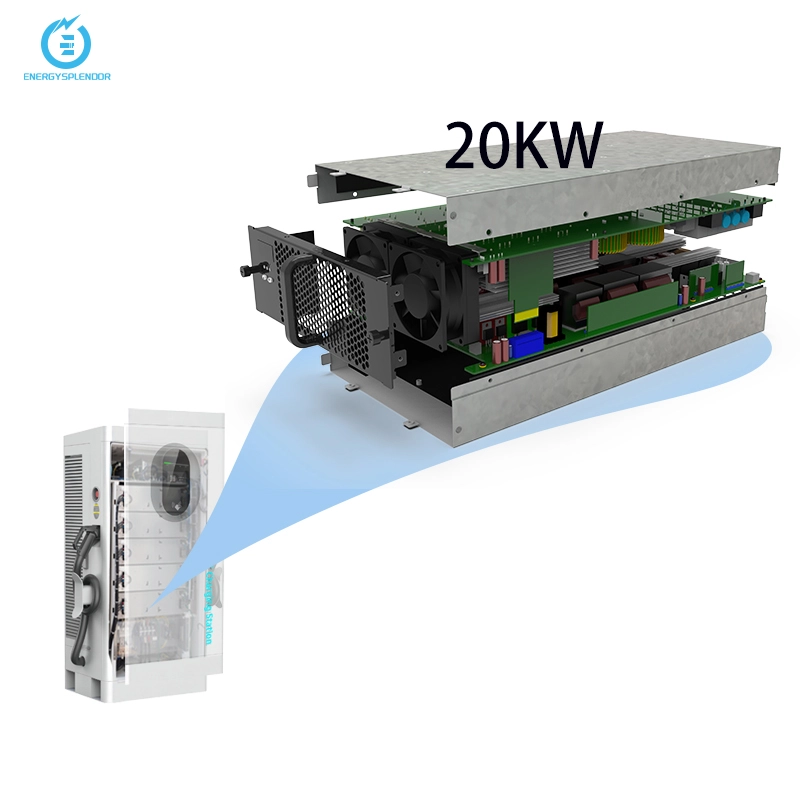
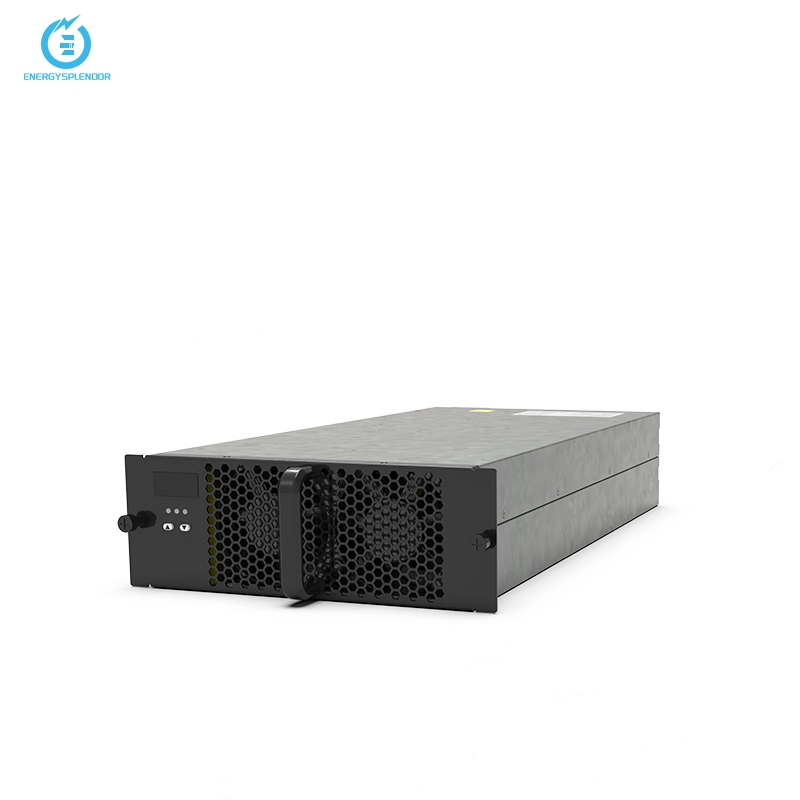
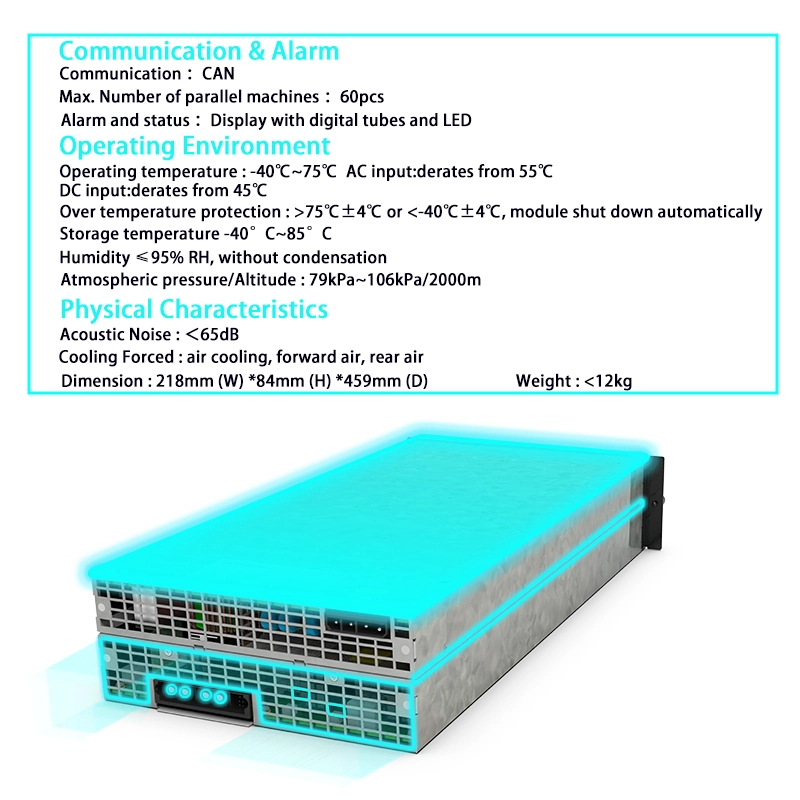
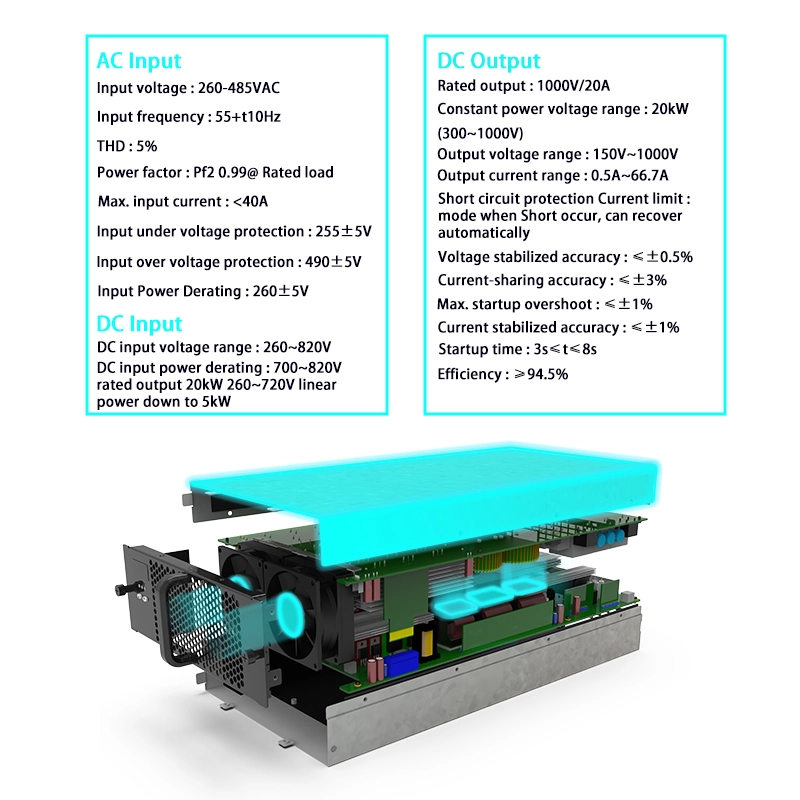
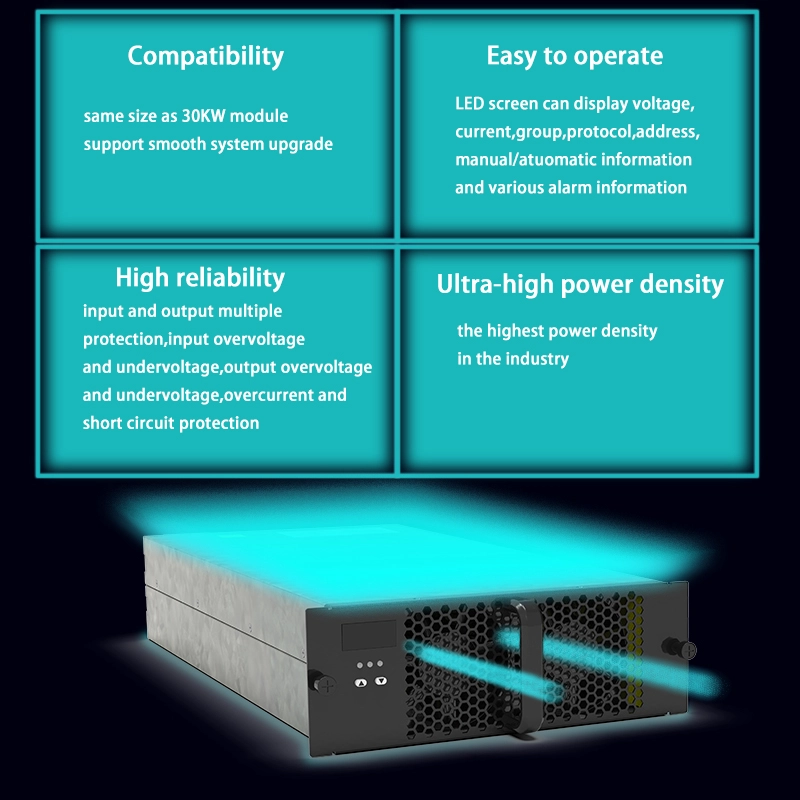
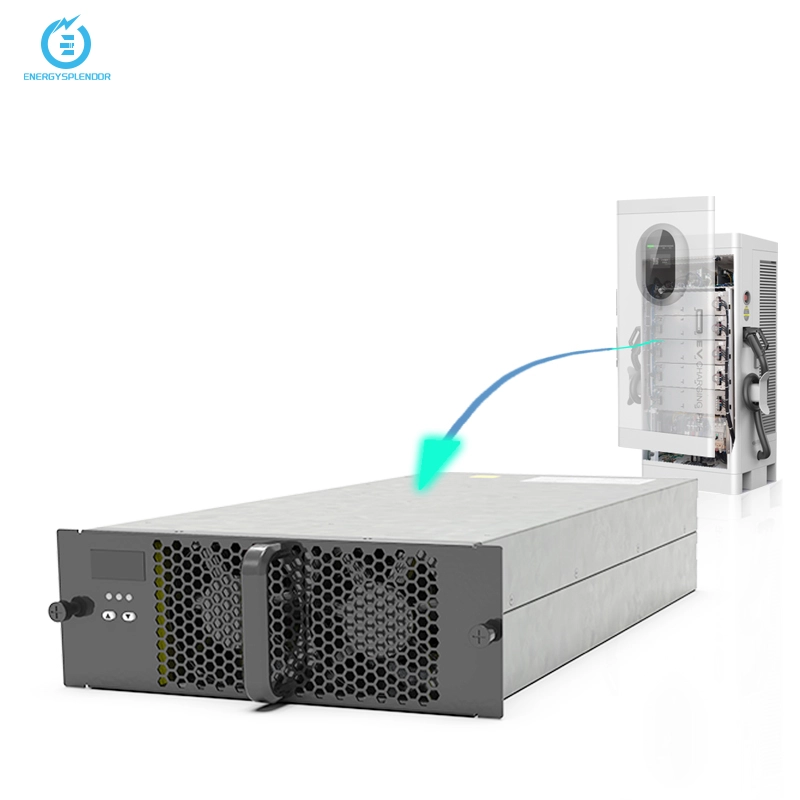
DC fast charger power module super wide constant power charging module is dedicated to application in the Fast EV Charging station. With the world’s leading power electronic control technology and design technique, the module has good performance of high power density, high effiffifficiency, super wide voltage range, wide operating temperature range which make the charging system high reliable and easy to design.
20KW EV Charger Module for AC to DC
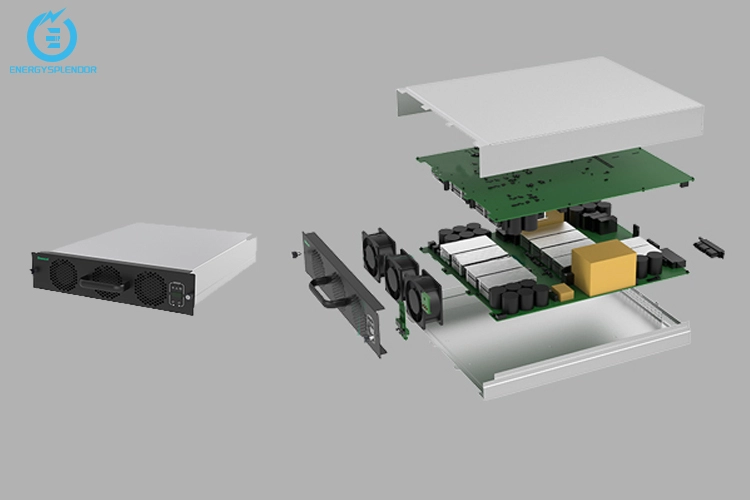
The 20kW EV Charger Module (AC to DC) offers fast and efficient charging, converting AC power to DC for rapid EV battery charging. With high power output, it reduces downtime, making it ideal for commercial and public stations. Features include energy efficiency, wide compatibility, advanced cooling, and safety protection (overcurrent, overvoltage). Its modular design allows scalability, and remote monitoring ensures smooth, reliable operation.
20kw EV Charger Power Module Efficiency
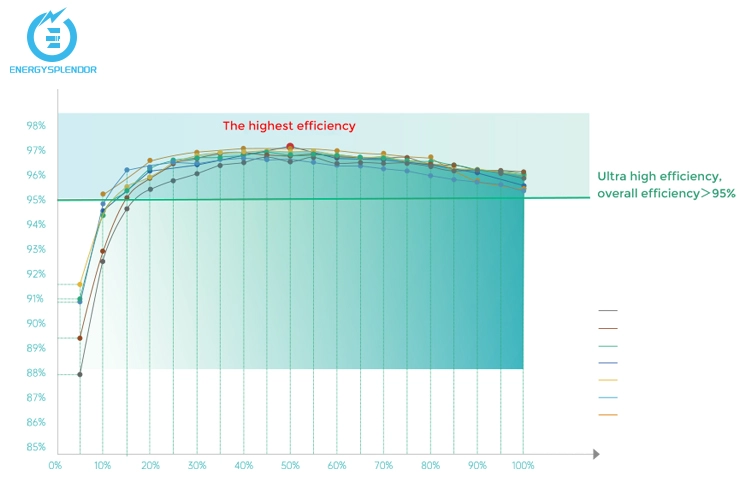
The graph you provided shows the efficiency curve of the 20kW EV Charger Power Module. It highlights that as the load increases, the module achieves ultra-high efficiency with overall efficiency greater than 95%. The highest efficiency is maintained in the upper range, indicating the module operates optimally at higher power levels, ensuring effective energy conversion with minimal losses across various load conditions. This high-efficiency performance ensures faster and more cost-effective charging for electric vehicles.
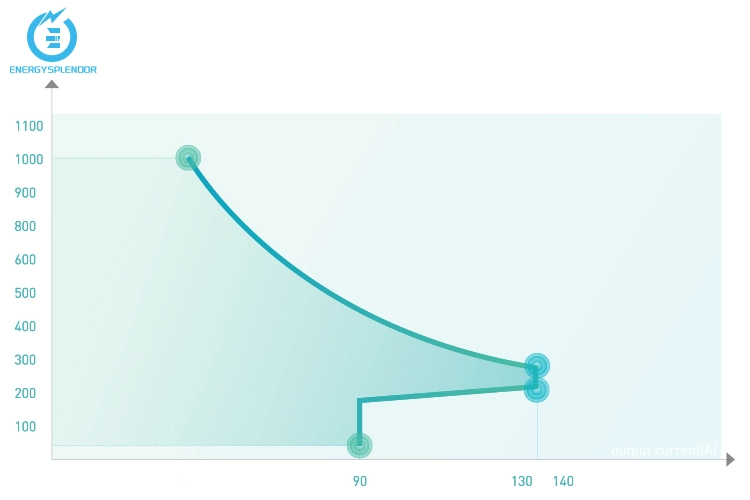
20kw EV Charging Module Output Current
The graph you uploaded shows the relationship between the output voltage (Vdc) and output current (A) of the 20kW EV Charging Module. It demonstrates that as the output voltage increases, the output current decreases. This inverse relationship is typical in power conversion systems, where higher voltage at lower current is used for efficient energy transfer. The graph likely indicates that the charging module adjusts the voltage and current dynamically to optimize the charging process while maintaining a stable 20kW power output.
We partnered with an EV charger module supplier for our production line, and the quality has been outstanding. The modules are efficient and stable, providing consistent performance across our AC and DC charging stations. They are compact and easy to integrate, helping us speed up assembly while maintaining safety and reliability standards. Technical support from the supplier has been responsive, ensuring smooth development and deployment for our projects. Choosing this EV charger module supplier has enhanced our product quality and allowed us to deliver reliable EV charging solutions to our clients.
Gregg Frederick
We integrated EV charging station power modules into our fast-charging products, and they have delivered excellent performance. The modules provide stable, efficient power output, ensuring fast and reliable charging for various EV models. Their compact design and high efficiency help reduce system size and energy loss, improving overall product quality. Integration was straightforward, and technical support was prompt, allowing us to accelerate project timelines. These EV charging station power modules have strengthened our charging solutions, helping us deliver consistent, high-performance fast chargers to our customers.
Philip Navarro
We use power modules for our EV chargers, and they have significantly improved our product performance. The modules deliver stable and efficient power output, ensuring fast and reliable charging for different EV models. Their compact and modular design makes integration easy, reducing assembly time while keeping our chargers lightweight and efficient. We’ve also seen lower energy loss and consistent operation under various conditions, which enhances the reliability of our chargers in the field. Using these power modules has helped us deliver high-quality EV charging solutions to our clients worldwide.
Danny Hodges
We integrated 30kW EV charger power modules into our DC fast chargers, and they have delivered reliable, high-performance results. These modules provide stable power output with high efficiency, ensuring fast charging for various EV models while reducing energy loss. Their compact design and modular structure make system integration and maintenance straightforward, helping us save assembly time and costs. The modules perform consistently under different environmental conditions, enhancing the reliability of our charging stations in the field. Using 30kW power modules has strengthened our product offering and improved customer satisfaction.
Connor Thomas
We sourced 30kW EV charger power modules directly from this factory, and the quality has been excellent. The modules deliver stable, high-efficiency power output, ensuring fast and reliable charging for our DC charging stations. Their compact, modular design makes integration and maintenance easy, reducing production time and costs. The factory provided professional support and timely delivery, helping us meet project deadlines for our clients. These 30kW power modules have strengthened our fast-charging product line, allowing us to offer high-performance and durable EV charging solutions to our customers worldwide.
Meredith Wilkerson
We integrated 40kW EV DC charger modules into our fast-charging stations, and they have greatly enhanced our product performance. The modules deliver stable, high-efficiency power output, enabling fast charging for various EV models while maintaining low energy loss. Their compact, modular design makes system integration and maintenance easy, helping us reduce assembly time and improve scalability. The modules perform reliably under different environmental conditions, ensuring consistent operation for our charging stations in the field. Using these 40kW EV DC charger modules has strengthened our fast-charging product lineup and increased customer satisfaction.
Amber Kemp
What is EV Charger Module?
An EV Charger Module is a power conversion unit inside a DC fast charging station that converts AC grid power to controlled DC power for charging electric vehicle batteries efficiently.
🔹 Key Functions:
✅ AC to DC Conversion:
Transforms AC grid power into DC power required by EV batteries.
✅ Voltage and Current Regulation:
Ensures stable, adjustable output to match different EV battery specifications.
✅ Scalability:
Modules are often stackable, allowing charging stations to increase or decrease power output (e.g., 30 kW per module, scalable to 60 kW, 120 kW, etc.).
✅ High Efficiency:
Designed for >95% efficiency to reduce energy loss and heat generation.
🔹 Where is it used?
✅ DC Fast Charging Stations:
Core power components in fast chargers at highways, commercial fleets, and public stations.
✅ Battery Energy Storage + Charging Systems:
Some systems integrate charger modules for grid balancing and EV charging.
🔹 Technical Features:
Power ratings typically 15 kW, 20 kW, 30 kW, 40 kW per module.
Modular design allows easy maintenance and replacement.
Supports CCS, CHAdeMO, and GB/T protocols via controller integration.
Features like PFC (Power Factor Correction) and isolation for safety.
Communication via CAN, RS485, or Ethernet for charger management systems.
✅ Why It Matters:
Reduces charger maintenance complexity by replacing modules instead of the entire charger.
Allows customizable charging power depending on site requirements.
Improves uptime and serviceability for charging station operators.
Enables future expansion without replacing the whole system.
✅ Summary:
An EV Charger Module is a scalable power conversion unit inside DC fast chargers, converting AC to DC with high efficiency and flexibility, forming the backbone of modular, high-power EV charging stations.
AC to DC EV Charger Power Module Working Principle
An AC to DC EV Charger Power Module is the core component in DC fast chargers, responsible for converting AC grid power into controlled DC power to charge EV batteries quickly and efficiently.
🔹 1️⃣ Input Stage: AC Power Intake
The module receives AC power (typically 380–480V, 3-phase) from the grid.
Includes EMI filtering to reduce electromagnetic interference.
Surge protection ensures safety against voltage spikes.
🔹 2️⃣ Rectification & PFC (Power Factor Correction)
AC power is converted into pulsating DC using a rectifier circuit.
PFC circuitry adjusts current waveforms to align with voltage, improving:
✅ Power factor (typically >0.99)
✅ Energy efficiency
✅ Grid stability
🔹 3️⃣ DC-DC Conversion
The pulsating DC undergoes high-frequency switching (via IGBT/MOSFET technology) in a DC-DC converter.
This stage:
✅ Smooths and regulates DC output
✅ Provides isolation between the grid and the vehicle for safety
✅ Allows adjustable voltage and current output depending on EV battery requirements
🔹 4️⃣ Output Stage: Controlled DC Power Delivery
Delivers regulated DC voltage and current to the EV via the charging cable and connector (CCS, CHAdeMO, GB/T).
Supports CC (constant current) and CV (constant voltage) charging modes for efficient battery charging.
🔹 5️⃣ Communication & Control
The module communicates with:
✅ Charging Station Controller (via CAN, RS485, or Ethernet)
✅ The EV’s Battery Management System (BMS)Adjusts output based on:
✅ Battery State of Charge (SOC)
✅ Temperature
✅ Safety status
✅ Summary of Process:
1️⃣ AC Grid Power →
2️⃣ Rectification + PFC →
3️⃣ DC-DC Conversion (with isolation and regulation) →
4️⃣ Stable, adjustable DC power output →
5️⃣ Battery charging under controlled communication with the EV.
🔹 Key Features of Power Modules:
✅ High efficiency (>95%) to reduce energy loss
✅ Modular, stackable design for scalable charging power
✅ Hot-swappable for easy maintenance
✅ Compact size with high power density (15–40 kW per module)
✅ Why It Matters:
The AC to DC power module enables fast, safe, and efficient charging for EVs while maintaining grid stability and high service availability for charging station operators.
What Types of EV Charger Power Modules Can We Provide?
We provide high-efficiency, modular AC to DC EV charger power modules designed for DC fast charging stations and integrated charging cabinets.
🔹 1️⃣ By Power Rating
We offer multiple power levels to match your station design needs:
✅ 15 kW Power Modules
Compact size, suitable for low-power DC chargers.
Enables flexible stacking for scalable power.
✅ 20 kW Power Modules
Widely used for small to mid-range fast chargers.
Balanced cost and power density.
✅ 30 kW Power Modules (Most Popular)
Ideal for scalable DC charging cabinets (60kW, 90kW, 120kW).
High efficiency, stable output.
✅ 40 kW Power Modules
Used for high-power fast chargers and ultra-fast stations.
Reduces module quantity needed per station.
🔹 2️⃣ By Output Voltage Range
We can provide:
✅ 150–1000V DC output modules for compatibility with a wide range of EV battery platforms, including passenger vehicles, buses, and trucks.
🔹 3️⃣ By Cooling Method
✅ Air-Cooled Power Modules
Lower cost, easy maintenance.
Suitable for most climates and standard fast chargers.
✅ Liquid-Cooled Power Modules
Higher thermal management efficiency.
Suitable for high-power chargers in hot environments.
🔹 4️⃣ By Application
✅ Standard DC Fast Charger Power Modules
For highway charging stations, fleets, and public fast charging.
Integrated into cabinets with user interface and billing systems.
✅ Portable DC Fast Charger Modules
For mobile charging trucks or emergency roadside charging.
✅ Bus and Truck Charging Modules
High-voltage, high-current output for heavy-duty EV charging.
🔹 Key Features of Our Modules:
✅ >95% Efficiency for reduced energy loss
✅ Power Factor Correction (>0.99)
✅ CAN/RS485/Ethernet communication for smart control
✅ Hot-swappable, modular, and stackable design
✅ OCPP compatibility via system integration
✅ Summary:
We can provide 15kW, 20kW, 30kW, and 40kW AC to DC charger power modules with air or liquid cooling, high efficiency, and wide voltage ranges for scalable, reliable EV DC fast charging solutions.
How to Use DC EV Charger Module in a DC Charging Station
A DC EV charger power module is used inside a DC fast charging station as the core AC to DC conversion and power delivery unit. It enables scalable, efficient, and reliable high-power charging for electric vehicles.
🔹 1️⃣ Understand System Structure
A typical DC charging station consists of:
AC Input: 3-phase grid power (380–480V).
AC Distribution & Protection Unit: Breakers, surge protectors, contactors.
DC Charger Power Modules: Convert AC to DC, regulate voltage/current.
Main Control Unit (MCU): Manages communication with EV (via CCS/CHAdeMO), charging session control, and billing.
Cooling System: Air or liquid cooling for module thermal management.
User Interface: Display, RFID reader, payment system.
Communication Gateway: Connects to backend OCPP platform.
🔹 2️⃣ Installation of Power Modules
✅ Rack-Mount the Modules:
Power modules are typically hot-swappable and rack-mounted inside the charger cabinet.
Ensure secure electrical and communication connections with the backplane.
✅ Cooling Setup:
Verify airflow clearance if air-cooled.
Connect coolant inlet/outlet if liquid-cooled.
✅ AC Input Connection:
Modules are connected to the AC input via the cabinet distribution system.
✅ DC Output Connection:
Modules connect in parallel on the DC bus, feeding regulated DC output for vehicle charging.
✅ Communication Wiring:
Connect CAN/RS485/Ethernet to the station’s MCU for monitoring and control.
🔹 3️⃣ Configuration & Commissioning
✅ Set output voltage and current limits according to the module and EV charging standards.
✅ Configure addressing and communication parameters if required.
✅ Perform test charging with load banks or test EVs to ensure:
Proper voltage/current regulation
Communication with MCU
Safety interlock functioning
✅ Integrate with the station’s user interface and payment system for session control.
🔹 4️⃣ During Operation
✅ The MCU controls each module’s output based on:
EV’s requested voltage/current
Battery SOC and temperature
Charging curve requirements
✅ Modules operate in parallel:
Power scaling according to load
Redundant operation (if one fails, others continue)
Hot-swappable for maintenance
✅ Active monitoring:
Efficiency tracking
Temperature and fault alarms
Load balancing between modules
🔹 5️⃣ Maintenance
✅ Regularly check:
Fan or coolant system (filters, fluid levels)
Electrical connections for tightness
Module status via the MCU for faults or degraded performance
✅ Faulty modules can be hot-swapped without shutting down the entire station.
✅ Summary:
To use DC EV charger modules in a DC charging station:
1️⃣ Install and connect modules inside the cabinet.
2️⃣ Wire AC input, DC output, and communication lines.
3️⃣ Configure and test charging operation.
4️⃣ Operate under MCU control with scalability and redundancy.
5️⃣ Perform routine monitoring and hot-swappable maintenance.
This modular approach ensures efficient, scalable, and serviceable high-power DC fast charging for EVs.
What Services Can We Provide as an EV Charger Module Supplier?
As a professional EV charger module supplier, we offer not only high-quality modules but also complete technical and business support to ensure our clients succeed in the competitive EV charging market.
🔹 1️⃣ Product Supply & Customization
✅ High-efficiency AC to DC charger modules (15kW / 20kW / 30kW / 40kW)
✅ Air-cooled and liquid-cooled modules for different environments
✅ Wide output voltage ranges (150–1000V DC) to match various EV platforms
✅ Support for CCS, CHAdeMO, GB/T charger integration
✅ Customizable modules (branding, software protocols) based on your project needs.
🔹 2️⃣ Technical Support & Integration Assistance
✅ Wiring diagrams and installation guides for your R&D and production teams
✅ Assistance in charger cabinet design (electrical layout, cooling planning)
✅ Firmware updates and parameter tuning to match site requirements
✅ Guidance on OCPP and backend system integration
✅ Troubleshooting and fault analysis during development or field deployment.
🔹 3️⃣ Testing & Certification Support
✅ Support in EMC, safety, and CE/UL certification processes for your end products
✅ Module testing reports (efficiency, protection, communication)
✅ Guidance for system-level functional and reliability testing.
🔹 4️⃣ After-Sales Service & Warranty
✅ Standard 1–2 year warranty with optional extended service plans
✅ Fast replacement and hot-swap support for faulty modules
✅ Remote diagnostics assistance for deployed projects
✅ Spare parts and accessories supply for maintenance stock.
🔹 5️⃣ Logistics & Flexible Supply Chain
✅ Support for sample orders for testing and pilot projects
✅ Stable mass production capacity to meet scaling needs
✅ International shipping with export documentation support.
✅ Optional Value-Added Services
✅ Charger cabinet ODM/OEM services in collaboration with partners
✅ Market insights for different regions to align your product roadmap
✅ Training for your sales and engineering teams to improve customer support.
✅ Summary:
As your EV charger module supplier, we provide:
⚡ High-quality, high-efficiency charger modules
⚡ Technical integration support and system design guidance
⚡ Testing and certification assistance
⚡ After-sales service and warranty
⚡ Flexible, reliable supply chain support
helping you build, scale, and maintain high-performance DC fast charging stations with confidence.
What Is the Function of the EV Charging Station Power Module?
The EV charging station power module is the core component in a DC fast charging station, responsible for converting AC grid power into stable, regulated DC power to charge EV batteries efficiently and safely.
🔹 Core Functions of the Power Module:
✅ 1️⃣ AC to DC Conversion
Takes three-phase AC power from the grid and converts it into DC power, which is required for EV battery charging.
✅ 2️⃣ Voltage and Current Regulation
Provides adjustable DC voltage and current output according to the EV’s battery requirements.
Supports CC (Constant Current) and CV (Constant Voltage) charging modes.
✅ 3️⃣ Power Factor Correction (PFC)
Improves the power factor to >0.99, reducing reactive power and ensuring efficient energy usage and grid stability.
✅ 4️⃣ Isolation and Safety Protection
Electrically isolates the grid from the vehicle for safety.
Provides over-voltage, over-current, over-temperature, and short-circuit protection.
✅ 5️⃣ Communication with Charger Controller
Communicates with the Main Control Unit (MCU) of the charging station via CAN, RS485, or Ethernet to receive commands and report operational status.
Allows dynamic adjustment of output based on the EV’s Battery Management System (BMS) requests.
✅ 6️⃣ Scalable Power Output
Power modules are designed to be modular and stackable, enabling the charger to adjust total power output by adding or removing modules (e.g., 15kW, 30kW, 40kW per module).
🔹 Role in the Charging Station System:
In the DC fast charging system, the power module:
1️⃣ Receives AC power from the grid via the distribution unit.
2️⃣ Converts and regulates it to DC power.
3️⃣ Supplies this regulated DC power to the charging gun connected to the EV.
4️⃣ Works under the control of the MCU, which manages the entire charging process, payment, and communication with the vehicle.
✅ Why It Matters:
Without the power module, the station cannot:
⚡ Provide the DC power required by EV batteries.
⚡ Control and adjust charging speed safely.
⚡ Enable modular, scalable charging solutions for different site requirements.
It is the critical engine of the DC charging station, ensuring efficient, fast, and safe EV charging.
✅ Summary:
The EV charging station power module converts AC grid power to regulated DC power, enabling fast, efficient, and safe charging for electric vehicles while communicating with the system controller for smart operation and protection.